Saturday, January 26, 2013

.Guest Post: How to Choose the Best Senior Products for the BEST PRICES


By Stephen Saldana on April 02, 2011


You know the choices you have in offering your pets the best in care, food, entertainment and comfort. Those can start as the cheapest of the cheap items at the "everything under $1" store all the way up to anything advertised as "gourmet", "luxury" or coming with a "designer" name tag. 

It seems that the options are endless and sometimes even overwhelming. But what we all want for our pets is the best pet products, for the best prices, without having to sacrifice quality for price. I mean, after all, our pets are nothing less than members of our personal families, right? Our senior pets deserve the best we can afford to give them for all those years of dedicated and unconditional love.


Well, there is a secret to getting the best prices on the senior pet products you're looking for, and the good news is that you don't even have to leave the comfort and convenience of your home to find them. With a little help from the internet, you are just a few clicks away from an amazing resource for educational information, comparative options and affordable solutions to the unique senior pet concerns and issues you are product shopping for.


Making sure you find sites with resources in taking care of your senior pet are important too. Finding the right places means you'll get to meet and get background information on the veterinarians and experts who know what they're talking about. 

Knowing that your research information comes from accredited and caring experts can go a long way in helping you find the pet products best suited to your senior pets needs at the best prices and can help save you a ton of money in the "trial and error" method of pet product shopping.


Many pet superstores have a great selection of across-the-board pet products, BUT some even offer items you may need that the others don't even offer like the best in therapeutic and rehabilitative products, mobility aids, ramps, steps, comfort/safety and travel products. This ensures that you are getting the best value for your pet care dollar and your beloved pet is getting the best in loving care.


Why try to "make-do" with products that aren't designed for the specific needs of your pet and why over spend trying to find just the right thing? Check out all the great resources online and see how much your senior pet will love you for taking care of them at the best price possible.


When Stephen Saldana's beloved dog started getting older, he found some senior pet products that would help with the problems of aging. 

SeniorPetProducts.com offers a large selection of pet products for senior dogs and cats with pet experts and info to help you and your pet


Friday, January 25, 2013

Classroom Pets: Good, Bad or Indifferent?

                    (Comments closed)  

Classroom Pets:  Used to be and CAN/CANNOT be GOOD.  Is sometimes BAD And is OFTEN DANGEROUS! (opinion article with facts and opportunities to learn from a 17 year long experienced teacher of pets in the classroom and how I learned to keep my job by NOT having them in the room!)

Sometimes teachers, especially of children in lower grades, find keeping classroom pets beneficial. The kids might not like coming to school to learn, but some enjoy their daily visit with the classroom pet. There are many considerations when selecting an appropriate pet for the classroom.

The REAL OWNER of the CLASSROOM "pet"
http://therealowner.com/adoption-rescue/getting-a-classroom-pet/


10 WORST animals to have in the classroom:


MIAMI, Aug. 18, 2011 /PRNewswire/ -- Classroom pets are an excellent way to teach young children about responsibility; however, deciding which animal is best suited to a noisy environment and constant human attention can be a daunting task. To make sure elementary school teachers know what to avoid, petMD.com has put together a list of the top 10 worst classroom pets.


# 10 - Snakes
Snakes don't shed, aren't noisy and, if you keep their habitat clean, don't emit a strong odor either. So, why don't snakes make good classroom pets? Their unpredictable temperament (especially when molting) can result in aggressive behavior towards inquisitive children. Most importantly, being reptiles, snakes have been known to transmit salmonella.
# 9 - Ferrets
These carnivorous members of the weasel family fall under the category of exotic (read: more expensive to care for) pets. Plus, they have a strong odor even after their musk glands have been removed. Generally, ferrets have excitable and aggressive dispositions. Even well-trained, they have a tendency to nip when they feel threatened. Overall, ferrets and small children are not a good combination.
# 8 - Birds
If children in your classroom suffer from allergies, you might think a bird would be a good fit -- but birds shed dander. They're also messy and noisy. Birds bite if handled too much, especially if they're not being handled gently. Also, all that classroom noise and activity isn't very peaceful; a nerve-wracked bird will pluck out its feathers. Finally, they can transmit bird diseases like parrot fever and salmonella.
# 7 - Rabbits
Thinking pet rabbits are safe for young children is one of the biggest mistakes teachers make when picking a classroom pet. Rabbits don't like to be handled and retaliate by biting or scratching with their strong hind legs. The House Rabbit Society has a downloadable PDF listing the criteria for keeping a rabbit as a classroom pet. Unfortunately, many don't meet the standard, especially in providing a peaceful environment.
# 6 - Frogs
Raising a frog to adulthood from the tadpole stage, or keeping an adult frog in a class full of young children is appealing but misguided. Why don't frogs make good classroom pets? Younger children will want to handle and pet the amphibian and that poses a considerable risk for transmission of salmonella. The Center for Disease Control provides vital information in this article: Reptiles, Amphibians and Salmonella.
# 5 - Hamsters
They're low maintenance and take up virtually no room, which makes this "starter pet" a top choice for teachers in the pet store. But hamsters are nocturnal rodents. This means disappointed children won't get to observe or interact with it at all. Also, the end result of a rattling the cage to wake up and play with "Harry the Hamster" is usually a bite.
#4 - Hedgehogs
Hedgehogs are nocturnal, which means they won't be in a good mood if they're woken up and will likely bite as a result. Falling under the "exotic" category, hedgehogs have very specific environmental needs, and their quills can be very irritating to young children.
# 3 - Chinchillas
Like hedgehogs and ferrets, chinchillas are nocturnal, excitable, and don't like to be handled. This pet needs to stay in constantly cool temperatures (under 85 degrees Fahrenheit) and to be set free daily so they can roam. Even considering taking a pet chinchilla to class for one day is considered a bad idea.
# 2 - Turtles
Their patience, hard shell and ease of care make turtles a seemingly perfect fit for the classroom. But like frogs and snakes, turtles commonly carry the disease salmonella, which is highly infectious and transmittable to humans. In addition, turtles are not as docile as people think.
# 1 - Iguanas
Iguanas are, in many ways, the least ideal pet to keep in a classroom. Like most reptiles, iguanas don't like to be handled. And because iguanas can grow to over six feet in length, a tail "lashing" can be quite dangerous to young children. Iguanas also have unique dietary needs and cannot subsist on greens alone.


So what animals do make for good classroom pets? According to the Humane Society, rodents such as rats, mice, gerbils and guinea pigs present less of a disease risk and are very sociable creatures. Goldfish are also an excellent choice for students who may suffer from allergies. They are relatively low-maintenance to care for and feed, and most importantly, they aren't disruptive to a healthy learning environment.

About petMD
petMD is a leading online resource focused solely on the health and well-being of pets. The site maintains the world's largest pet health library, written and approved by a network of trusted veterinarians. petMD was founded to inspire pet owners to provide an ever-increasing quality of life for their pets and to connect pet owners with pet experts and other animal lovers. petMD is a subsidiary of the Pet360 family of brands, which also includes www.PetFoodDirect.com -- the most complete pet food and supply retailer online, and www.NationalPetPharmacy.com -- a fully certified, full-service pet pharmacy delivering pet meds, vitamins and comprehensive pet health and wellness products.
Contact:
Kelly Lange
610-234-4114
klange@pet360.com
SOURCE petMD.com


Comment on this story, by email comment@newsblaze.com  
Article is being posted here for EDUCATIONAL (by an educator) for learning.  No copies of this article may be reproduced in any form without written permission. 

SOMETHINGS THAT ARE SUGGESTED TO DO:

http://www.usask.ca/education/coursework/mcvittiej/resources/livingthings/animals.htm

http://www.ehow.com/how_2092134_teach-children-animals.html

http://k6educators.about.com/od/classroommanagement/a/Classroom_Jobs.htm

http://www.kinderart.com/teachers/pets.shtml

DIFFERING OPINIONS, POSITIONS AND FACT ABOUT ANIMALS AS "PETS" IN THE CLASSROOM:

http://www.animalearn.org/elementaryLaws.php

(some of this is about dissection!) (some of the material may upset you and others of you ... like me... will join in the movement and obey the laws!)


http://www.dnr.state.oh.us/Portals/9/pdf/pub009.pdf
 Deals with OHIO...  PDF file...

http://www.nsta.org/about/positions/animals.aspx
  Science Education positional statement about the use of animals in the classroom.  This is a PRO article... with the some of the best information I have found!

http://www.reacheverychild.com/feature/pets-classroom.html
   An incredible collection of links and ideas and opinions and facts about the use of animals in the classroom.  Another favorite article of mine with incredible information!

http://www.mspca.org/programs/humane-education/resources-for-educators/animals-in-education/school-policy-on-classroom.html
    MSPCA is an incredible organization with a great wealth of information on this topic.


http://www.mdk12.org/instruction/curriculum/science/safety/safety.html
   Safety....  are teachers RESPONSIBLE in the classroom?  Have they been trained to handle certain animals?  And much more...

http://www.mbm-law.net/newsletter-articles/when-dogs-go-to-school-%E2%80%93-service-animals-in-the-classroom/
  Service Animals in the Classroom  (you don't need to have other animals in the classroom...  they are a MAJOR distraction and unfair to the student(s) with the special needs.


Final Note:  Since we are NOT encouraging animals in the classroom but rather animals that come to schools with their animals that are trained for the in-class visiting only, we will not be adding any thing else in comments.   If you have questions about this subject, you should call your local SPCA and ask how you can help them and how they can help you.  Thank you!


Thursday, January 24, 2013

Dog Clothes - How to Select Dog Clothes


Dog clothes. Yes dog clothes. Let's face it. Dressing up our dogs is a guilty pleasure. And as long as it's done in good humor, and not to provoke, hurt, or embarrass someone (especially the dog), it's harmless fun. Some dog clothes can actually benefit our pets, keeping them warmer in winter, and cooler in the summer. But it's important that you never mock or ridicule your dog while the animal is wearing dog clothes. They may believe they've done something wrong, and will become resistant to being dressed. So what should you look for when buying dog clothes?

Features to Consider When Buying Dog Clothes

  • Materials
  • Size
  • Color
  • Durability
  • Safety
  • Washable
  • Style
  • Design

    Desirable Features in Dog Clothes
  • Easy put on
  • Comfortable to pet
  • Attractive
  • Washable/won't shrink
  • Colors stable
  • Won't show dirt - for dogs that like to roll in the mud

    Whether it's for fun (Hawaiian shirt, hat, sunglasses), or for comfort and safety (sweater, paw protectors), you'll want to select dog clothes made from sturdy, lightweight fabrics that are easy to clean. Check the care labels carefully and make sure the dog clothes you buy aren't going to shrink, fade or wear excessively with normal washing. Check the seams and stitching for quality and durability.

    The design, color and style of dog clothes is up to you—your dog probably won't express a preference. Hats, sunglasses, shirts and more can add color, fun and style to your dog's next outing. Even dog clothes designed for safety, such as reflector vests and rain gear, can be stylish when the colors of the dog clothes are coordinated with your dog's coat.

    Make sure the dog clothes fit comfortably, with no rubbing or chafing, especially in sensitive areas like the belly and under the arms. Unless your dog is wearing a ‘diaper' recommended by your veterinarian for bowel or bladder problems, the dog clothes should stop at the rib cage, allowing your dog to safely eliminate without soiling the clothes.
           
    Ideal Choices - “Do These Dog Clothes Make Me Look Fat?”

    The ideal dog clothes are lightweight and comfortable, with easy fastening snaps or straps. They are attractive, inoffensive, and designed with your dog's comfort and safety in mind. They're washable, durable, and won't easily show dirt. Well-fitted dog clothes are loose at the neck, and stop at the elbow, and at the rib cage to allow your dog maximum freedom of movement. Dog clothes should allow you dog to ‘do his business' without getting soiled.

    Safety and Shopping Tips for Dog Clothes

    Dog clothes safety is key. Because of the danger of getting snagged, or the tendency of other dogs to want to play ‘tug of war' with the dog clothes your dog may wear, you should never allow your pet to wear dog clothes unsupervised. To avoid potential problems, keep your dog on a leash when wearing dog clothes, or confined in your home, or fenced-in yard, under your direct supervision.

    For further safety, avoid dog clothes that have ties or straps that might constrict your dog's breathing, or interfere with bowel or bladder function. And make sure that the dog clothes you choose can be pulled off easily in an emergency.

    Dog Clothes Have Fun

    When choosing and using dog clothes, have fun. And let your dog be in on the fun, not the butt of the joke. Dressing alike, or in complimentary costumes on special occasions; can be a great way to share good times with your best friend. 
  •  http://www.petproductadvisor.com/buyers-guide/dog-clothes-how-to-select-dog-clothes/148/page1.aspx

    Wednesday, January 23, 2013

    Wordless Wednesday My kind of dog AND my dog Sandie

    Sandie is a RESCUE DOG and she's 10.5 year's old and in great condition. You will see her at the end of the pictures!  We belong to PAWS!
    The Perfect Breed!

    HaHa, I can lay on the side of the street and take a nap, you have to go home to your bed!

    One step forward, two steps back!

    I'm pooped Mommy!  I partied til the sun came up!

    I'm on the couch and the cat is in the bathroom in the tub! 

    I wish she wouldn't do this.  Ouch, don't pull on my cheeks!

    This is my SMILE and new PEDICURE!

    Show is over... go home!


    Sandie and John at the New Year's Party

    Sandie eating YOGURT from a spoon with John

    Sandie CLEANING up the left over yogurt in the cup!


    Hi!  Thanks for visiting my page and please comment while you're here and tell me what your favorite(s) picture is!  Thanks!

    Tuesday, January 22, 2013

    Golden Retrievers Cancer Study: Playful Breed May Be Key To Canine Health Breakthrough

    Beautiful Goldens!  Internet image.  Permission to post by me.
     LOS ANGELES (AP) — When Jay Mesinger heard about a study seeking golden retrievers to help fight canine cancer, he immediately signed up 2-year-old Louie.
    He and his wife know firsthand the toll of canine cancer: Louie is their fourth golden retriever. The first three died of cancer.
    "They all had long lives but were taken by complications from one kind of cancer or another," said the businessman from Boulder, Colo.
    For Louie and 2,999 other purebred goldens, it will be the study of a lifetime. Their lives — usually a 10-to-14-year span — will be tracked for genetic, nutritional and environmental risks to help scientists and veterinarians find ways to prevent canine cancer, widely considered the No. 1 cause of death in older dogs, said Dr. Rodney Page.
    The Golden Retriever Lifetime Study will be the largest and longest dog study ever conducted, said Page, the study's principal investigator, a professor of veterinary oncology and the director of the Flint Animal Cancer Center at Colorado State University.
    The study will focus on three cancers that can be fatal to the dogs, including bone cancer, lymphoma (cancer of the lymph nodes) and a cancer in the blood vessels called hemangiosarcoma, Page said. He also expects the data to yield information about other dog diseases, like arthritis, hip dysplasia, hormonal and skin disorders and epilepsy, he said.
    The Morris Animal Foundation, a 64-year-old group based in Denver, is providing much of the $25 million needed for the study. The rest will be funded through online public donations that allow people to sponsor one of the 3,000 canine volunteers.
    The study is recruiting purebred golden retrievers under the age of 2 whose pedigree can be traced back at least three generations. The breed was chosen because "they are very common. They are the fourth- or fifth-most common dog recognized by the American Kennel Club. They are wonderful companions for people and found in every walk of human endeavor," Page said.
    Researchers were seeking young dogs because "knowing the history of their lives provides huge advantages," Page said. Those involved in the study compared the work to the Framingham Heart Study, which has tracked a group of humans and their descendants from Framingham, Mass., since 1948.
    Dr. Nancy Bureau, Mesinger's veterinarian at the Alpine Animal Hospital in Boulder, said that given the condensed lifespan of a dog, it might not take a decade to see results from the study.
    "Before this group of volunteer dogs has left this world, hopefully we will have data to help even them," she said.
    A pilot study of 50 dogs started in August 2012, and Page said preliminary results from that first group should be ready soon and reportable results could be possible in a year.
    Work on the study started about four years ago. After funding was approved, scientific and research teams were formed, the database was set up, a bio-lab found to store the samples and a questionnaire was written.
    The recruitment of volunteer dogs was expected to be done in two years, with most of it spent on verifying eligibility and participation. Page said it takes about four weeks to verify pedigree and health, and make sure a dog's owner and veterinarian will participate. So far, 200 dogs have accepted the invitation, and 600 others are on a waiting list.
    Bureau, who also has a golden retriever client on the waiting list, said it's a privilege to be part of a groundbreaking study. Aside from researchers, participating veterinarians probably have the most work — they have to submit samples of blood, urine and hair during annual exams and report whenever they treat a volunteer dog for any reason.
    Study leaders will not intervene or recommend any treatment, Page said. "We will work with the vets working with the pets. We will catalog all the things that happen, the medical history, the diet, environment and exposures."
    The vets hope the study eventually will benefit humans. Researchers will pay particular attention to early onset obesity in dogs to see how it is related to diabetes, Page said.
    Dog-years are a benefit to researching ailments found in both dogs and humans, because studying a dog for 10 years is akin to studying a human for 60 or 70 years, said Dr. Wayne Jensen, the Morris Animal Foundation's chief scientific officer and executive director.
    "There are many examples where risk factors in dogs have also been found in people," said Jensen.
    The study will also try to measure factors in a dog's life, such as how fun and an owner's love affect the animal's health and longevity. That will be attempted through questions about the number of children or other pets in the owner's family, the amount of time spent together — and the dog's sleeping spot.
    Mesinger knows the answer to that one off the top of his head: "In bed, with my wife and I."
     http://www.huffingtonpost.com/2013/01/22/golden-retrievers-cancer_n_2524384.html
     
     
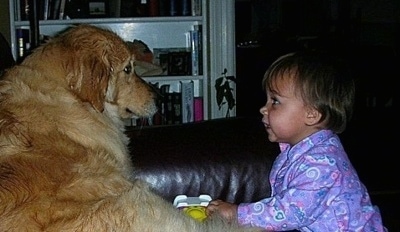
    Abby, the 5 year old Golden Retriever with his human baby friend

     The Material contained herein may not be reproduced without the prior written approval of the author.

    Animal lovers keep pets warm!

     
    Sandie (my dog) and her daddy!

    January 13, 2013

    Animal lovers keep pets warm

    When the winter winds blow or the spring rains fall, animals need to stay warm and dry as much as people do.
    Sadly, some owners don’t realize or care that Illinois law requires outdoor animals to have adequate shelter, as well as food and water. They can end up in court if the pets aren’t protected from the cold, rain and sun.
    Animal lovers are coming to the rescue with organized drives to collect unused dog houses and materials to build the houses. And, of course, monetary donations are always appreciated, and will be used to buy the houses and materials.
    The Humane Society of Danville is seeking dog houses that aren’t in use.
    “We would see it got to an animal without proper shelter,” said Pat Miller, an employee at the shelter.
    When the agency receives a complaint about a dog without shelter, Miller said the owner is given 48 hours to come up with a house. If that doesn’t happen, then the next step is court, and that could take another 30 days.
    In the meantime, the dog suffers.
    In some cases, the family loves the dog, but is unable financially to buy a shelter within that length of time. Sometimes, an owner will surrender the dog rather than provide shelter.
    If the Humane Society can provide a dog house, then that helps the dog and also might keep the dog from being surrendered. “Maybe this will help out all around,” Miller said.
    Also, Miller said, she knows someone who is willing to build dog houses if the Humane Society gets supplies.
    Any type of dog house that’s in good shape — that is, it doesn’t have big holes — will be accepted. Call the Humane Society to arrange for pickup in the city. The agency also will clean out the house.
    Also, call the society if you have building material. Construction companies, for example, might have material leftover after a job.
    The Humane Society will provide straw for the houses, Miller said. Straw is better than blankets, which can get wet and freeze.


    Warm paws
    Another group in Danville has a similar goal — and has already collected $600 to help pets.
    Operation Warm Paws is a project sponsored by the Danville Education Association. Students, teachers, staff, and administrators throughout District 118 have supported the Operation Warm Paws initiative.
    Michelle Collins, a seventh-grade teacher at South View Middle School, said DEA does two to three major projects each year to help the community. This is the second year that a project has revolved around helping animals.
    Last year, donations of food, dog beds and money were divided among the three animal shelters in the county.
    This year, the group hopes to collect money and/or building materials by the end of this month, and then have a building party in February, Collins said.
    Since the fund drive started at the beginning of December, more than $600 has been collected.
    Collins said, “The donation total was outstanding because other fund drives were going on, too, for Hurricane Sandy victims and local food banks. I am so proud of District 118 students, fellow DEA colleagues, District 118 administrators and staff because they have given and given to various causes throughout the year. However, they did not hesitate to give one more time to help the animals of our community.”
    Collins said a staff member has already drawn up a blueprint for a dog house, and others have volunteered to build them. Wood pallets are especially needed.
    Once the houses are built, they will be distributed among the three animal shelters (the city, county and CARA, a no-kill shelter in Tilton).
    On behalf of the Danville Education Association, Collins said, “Thank you to everyone that has supported and will support Operation Warm Paws.”


    Hoopeston
    In northern Vermilion County, animal control officer Sherry Klemme supports Operation Warm Paws, calling it a “great effort.”


    She has collected homes for outdoors dogs, but can always use more.  People who know of a dog or cat that needs a shelter or a better shelter are asked to contact her, as well as anyone who has a dog house they’re not using. “I’ll hold onto it until I need it,” she said.

    As part of her job, Klemme knocks on doors and informs owners of state laws regarding shelter, tags, vaccinations and other issues. She makes sure dogs are up-to-date with shots and registrations, but she also wants them to be warm.
    “I don’t encourage outside pets,” she said. “It’s one of my pet peeves.”

    Happy Sandie getting her yogurt on her ice cream spoon just for her!

    Happy dogs
    Most die-hard dog lovers agree with that sentiment, and make sure their pets are toasty warm in winter.
    One of those is JoAnne Andrews of rural Alvin, who has seven dogs — two Pomeranians, two small Eskimo dogs, two Great Pyrenees and a border collie.
    “I know they’re happy dogs,” she said.
    She and her husband, Neil, have had 16 dogs over the past 25 years.
    The most recent additions are her Great Pyrenees, Telah Hope and Tirzah Joy. JoAnne had gone to look at the puppies last April, and hoped her husband would get her one for Mother’s Day (thus, the name, Telah Hope). When he let her have two puppies from the litter, she had “tears of joy” — and that led to the second name, Tirzah Joy. In keeping with her other pets’ names, Telah and Tirzah are names found in the Bible.
    The winter-loving dogs go outside to play, and they have their own playhouse — a plastic children’s house that the Andrewses had bought for the grandchildren 12 years ago.
    The dogs fit inside the house, and there’s room for JoAnne to come in and visit with them. The doors open and shut.
    “They don’t mind if it’s snowing,” JoAnne said. “Their hair is thick.” However, she noted that dogs do need shelter from the wind.
    The dogs enjoy the best of both worlds — playtime outdoors and snuggle time indoors.
    Personally, I agree that dogs should be allowed to come into the house, and my own dogs are proof of that. The Humane Society of Danville, the DEA and other animal lovers are to be commended for caring about what happens in other people’s backyards.
    No animal should have to endure the biting cold (and that includes farm animals, as well). I know local people will step up with donations of dog houses and building materials so all pets can have a comfortable life.


    To help
    — In the city, call the Humane Society of Danville at 446-4110 to arrange for pickup of dog houses or building materials.
    — In Hoopeston, call the animal control officer at 283-5196 if you have a dog house to donate.
    — To donate to Operation Warm Paws, send a check to the Education Personnel Federal Credit Union, 1102 N. Walnut St., Danville, IL 61832, and indicate it’s for Operation Warm Paws. For more information or to donate building supplies, call 260-5895. Deadline is the end of January.


    Where’s Peaches?
    The Vermilion County Animal Shelter Foundation is asking for help in returning a dog to safety.
    Peaches is a 2½-year-old Yorkshire terrier mix with a tan/red coat. She ran away from the Village Mall on Jan. 5 during an adoption clinic event and has not yet been retrieved.
    She has been seen daily since then traveling the area around the Danville Boat Club near Walnut Hill Court. She also has been seen coming in and out of the woods across Denmark Road directly across from Boat Club Road.
    Peaches is a very shy dog and ignored several attempts at being called to come, though she does know her name. Peaches is scared and hungry and is known to like hot dogs as a treat.
    Anyone who sees a dog fitting her description or has found and taken her in is asked to call 554-5452 (during the weekday only), 213-9595, 474-3076, 274-8606 or 918-2861 immediately.


    The Pets column runs every four weeks. If you would like to have your pet featured, contact Mary Wicoff at 477-5161, send an e-mail to mwicoff@dancomnews.com or write to Commercial-News, 17 W. North, Danville, IL 61832.

    Wednesday, January 16, 2013

    Wordless Wednesday I LOVE NAILS Jan 16 2013


    I sell Avon Nail Polish!  If you are interested please go here:  http://cmullin.avonrepresentative.com/

    Do you need Valentine's Day Nail Polish?  Just go to this link again and choose the NAILS section for great values and they will be there within ONE week of your order, sometimes just a couple of days! http://cmullin.avonrepresentative.com/


    I can do these for you for a moderate fee!  Just ask me at carolynjm@live.com  thanks!


    Avon Nail Polish!

    Get Well Soon Coupon and Bigelow Tea Giveaway Ends 01/22/13


      WIN IT WEDNESDAY!  Get Well Soon 100 Coupon Giveaway!
    I know that the flu/virus/cold's are just happening all over the USA so I thought that this would be the best giveaway...  And I'm going to add some TEABAGS!  Decaf Gingerbread Spice...  Mmmm!

    And you will have the chance to win FREE Bigelow Tea Bags in this giveaway as well...  but you have to do the step in the Rafflecopter in full, to win that entry.

    The giveaway gives some Gingerbread Spice Decaf. tea bags and then another entry gives 10 of a variety of Bigelow Tea Bags!

    Hope you are not looking like this for long.... but it's the winter and it happens...   stay away from people who have the flu/cold/virus and here are some tips to know about getting the flu and what to do if you don't know already.

    RAFFLECOPTER: a Rafflecopter giveaway

    See the rules for the Rafflecopter at the end of the form and be sure that you RESPOND to my email notification within 48 hours from receiving the message or I will pick another winner :o)

    WINNERS receive:

    1. First pulled Winner:  100 Cold and Flu GET WELL SOON type coupons and some Gingerbread Spice teabags!   That winner is:

    Colleen Schilinski!!

    2.  Second pulled Winner:  50 Coupons:  P&G!  Sticking with the GET WELL SOON theme!  That winner is:

    3.  Third pulled Winner:  Bigelow Variety Tea Bags (approx. 10) That winner is:  


    Have you gotten your flu shot?  Don't be one of those people who "claim" that they get the flu from the flu shot because that is just not true!  
     

    Flu outbreak: Why are so many not getting vaccinated?
    The CDC recommends everyone who is over the age of 6 months get a flu vaccine.  The people most at risk for developing complications from the flu include people over the age of 65, pregnant women, and those with asthma, emphysema and chronic lung disease. However, the majority of Americans do not get the flu shot each year – with only 46 percent getting the vaccine by the end of March 2012.  And, the success rates are fairly positive –  flu shots were shown to be 67 percent effective in preventing the flu.

    So why do so many people skip getting the vaccine?  According to one doctor, people do not actively reject the vaccine.  Instead they are merely unsure of whether or not they really need it.

    Myths vs. facts
    “There’s a growing problem called ‘vaccine hesitancy,’” Dr. Frank Esper, a viral respiratory disease expert at UH Case Medical Center in Ohio, told FoxNews.com.  “They’re not truly against getting the shot.  But, with all these people online saying, ‘Watch out for this, be careful about that,’ – they’re hesitant to receive the flu vaccine, and then they never get it done.”

    According to Esper, with numerous websites, blogs, and podcasts perpetuating false information about the flu vaccine online, it’s easy for people to doubt the vaccine’s safety or believe it was not tested accurately.  Many fear the vaccine will cause adverse side effects, which is an unrealistic fear, Esper said.

    “There were certain vaccines in the past that did cause problems,” Esper said, alluding to a 1976 vaccine that caused Guillian-Barre syndrome (a neurologic disorder) in a small amount of people.

    “It happens once, and people start saying how the [vaccine can cause severe problems].  But all these vaccines that we are producing in the U.S have been tested for this problem, and all sorts of other problems and have been well proven to be safe and effective,” Esper added.

    Apart from the hesitancy surrounding the flu vaccine, there are also a number of propagated myths associated with the shot.

     The biggest one: You can get the flu from getting the flu shot.
    Because the flu vaccine is developed utilizing parts of the influenza virus, many people believe the virus in the vaccine can ultimately make them sick. But Esper laid that myth to rest.

    “The flu shot has absolutely no live virus in there,” Esper said.  “It’s a bunch of pieces and parts.  Think of it as if I take the flu, chop it up into little bits and put those bits into the shot.  You cannot get the flu from the shot because it doesn’t contain all the parts of the flu virus.”

    To emphasize his point, Esper noted a person cannot get the flu from the flu shot, “no more than you can get three tires and a carburetor and drive a car.”

    However, just because a person does get the flu vaccine doesn’t mean he or she won’t still get sick.  However, many people can mistake flu-like symptoms for the flu virus.  Esper noted there are many different viruses capable of causing disease, so people shouldn’t necessarily assume that if they are sneezing and coughing, they caught the flu virus.

    Another myth people have is they think they cannot get the flu.  People who haven’t had the flu in years’ past think they are somehow immune to the virus – a mind set that is potentially unsafe for not only themselves, but others around them.
    “The answer to that is, ‘Well you may not have gotten sickly,’” Esper said. “Just like the flu can cause really bad disease, you can actually just have a little bit of a runny nose and nothing else – and that’s still the flu.  It’s still something you caught and you can spread to others.”

    Credit:  http://www.foxnews.com/health/2013/01/10/flu-outbreak-why-are-so-many-not-getting-vaccinated/

    Some key things to know about the flu season:

    THE SITUATION: The annual flu season hit about a month early this year, and illness is now widespread in 47 states. Many cases are caused by a flu strain that tends to make people sicker. But so far experts say it's too early to know whether this will end up being a bad season. Maybe not: There are signs the flu may have already peaked in a few states, though it's too early to tell for sure, health officials say.
    THE VACCINE: This season's vaccine is well matched to the circulating strains, and there's still some available. It is 62 percent effective, according to government study results released Friday, which is pretty good for a flu vaccine. Health officials are urging people to get vaccinated; it's recommended for everyone 6 months or older.
    THE DEFENSE: Besides getting a flu shot, wash hands with soap and warm water, and avoid touching your eyes, nose and mouth. Keep away from sick people.
    THE TREATMENT: Most people will get a mild case and can help themselves and protect others by staying home and resting. But people with severe symptoms should see a doctor. They may be given antiviral drugs or other medications to ease symptoms.

    COLD OR FLU?: Influenza is not the only bug making people sick. The cold virus and a nasty stomach virus are also going around. It can sometimes be hard to tell the difference, but cold symptoms include stuffy or runny nose, sore throat and sneezing. Flu usually involves fever, along with chills, headache and moderate-to-severe body aches and tiredness. Symptoms can come on rapidly, within three to six hours.


    Facebook:

    Sniffly, stuffy, sneezy and achy and want someone to blame, just to make yourself feel mildly better? There’s now an app for that.
    “Help, I Have the Flu” is a new Facebook app that trolls through friends’ profiles looking for keywords such as ‘sneezing,’ ‘coughing,’ and ‘vomiting’ as well as check-ins to find the culprit who may have passed on the virus.

    “Hello. I’m sorry you have the flu,” reads the app. “Nothing will make you feel better like finding somebody to blame.”

    Clicking on the “Who Made Me Sick” button on the Facebook page will track down prime suspects, such as those who’ve mentioned the word ‘flu’ in their status updates or those who’ve had multiple late night posts, as sleep deprivation, the app reasons, puts people at increased risk for catching a cold.

    The app also allows users to send a message to the offending virus-spreader or purchase remedies from the healthcare company that runs the app, Help Remedies in the US.
    Meanwhile, the Centers for Disease Control and Prevention also has an app that tracks flu activity reports in the US through podcasts and feeds, while the Flu Defender provides handy tips on how to protect yourself this season.


    Cold and Flu Coupons for you!
    $2 Off Sudafed Product Coupon
    $1 Off Chloreseptic Product Coupon
    $1 Off Robitussin Product Coupon
    $2 -$3 Off Theraflu Product Coupons
    $1 Off ZarBee’s Cough Syrup Coupon
    $1 Off Little Remedies Product Coupon
    $1 Off Tylenol Coupon
    $1 Off Advil Product Coupon – Use the scroll bar to switch between products – middle of the page.
    $1 Off Excedrin Extra Strength Coupon


    Recommending the Right Products for Cold and Flu Season:
    http://www.pharmacytimes.com/publications/issue/2010/November2010/OTCFocus_ColdandFlu-1110

    This year I recommend:
    http://conversationswithcarolyn.blogspot.com/2013/01/cordicin-is-best-cold-and-flu-tablets.html
    I hope you have gotten your flu shot and that you are staying home from public places since this has been ruled an epidemic.  You can still get the flu even if you had the flu shot.  I hope that you feel better soon if you are sick.


    Related Posts Plugin for WordPress, Blogger...